Accessories that fit a Suzuki Jimny
Modified more often than almost anything here, and the three-door and five-door take different body parts.
Search the full index for your exact year →
Windows & screens for the Suzuki Jimny
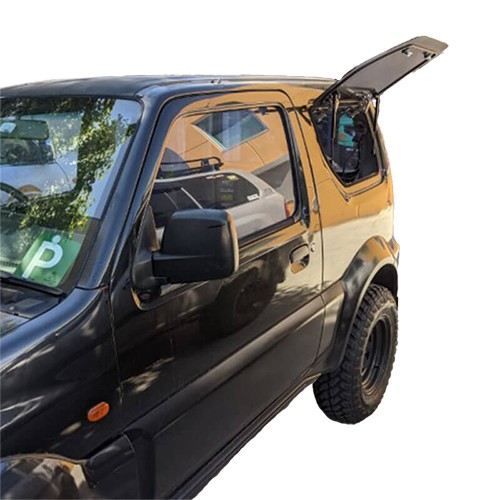 Confirmed fit
Tough Toys
Confirmed fit
Tough Toys
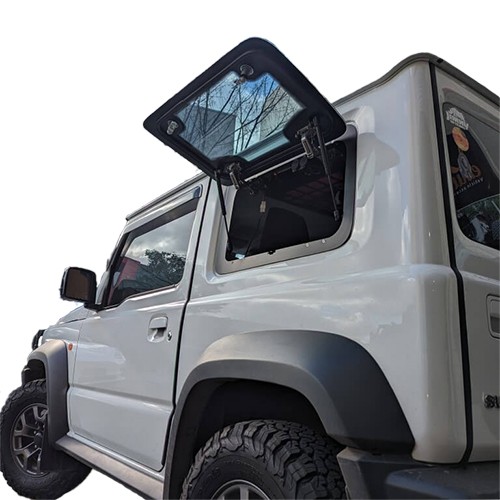 Confirmed fit
Tough Toys
Confirmed fit
Tough Toys
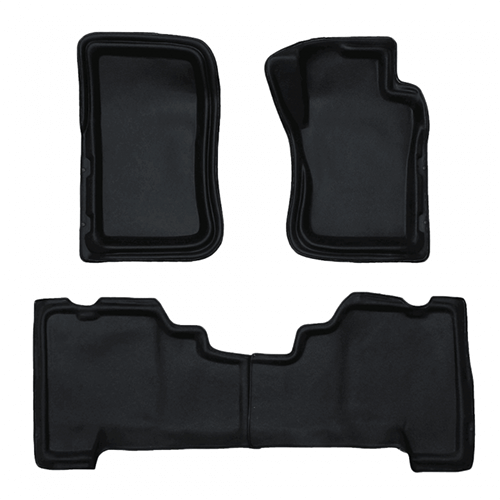
Mats & interior for the Suzuki Jimny
Series codes for the Suzuki Jimny
Australian retailers state fitment by series, not by model name. These are the codes you'll see in listings for this vehicle — the chassis codes in brackets mean the same generation and often appear instead.
Your build plate is the authority — a model can change series part-way through a year, and Australian delivery often lags the global launch. How to find your series.
Three-door and five-door are not the same vehicle
Both are JB74. That is the trap, because the series code — normally the thing that settles fitment — doesn't distinguish them at all.
The five-door, sold here as the Jimny XL, is roughly 340mm longer in the wheelbase. Anything dimensioned along the body is specific to one or the other: side steps, rock sliders, roof racks and platforms, rear bars, awnings and anything that mounts to the rear door. Bull bars and most drivetrain parts carry over.
A listing that says "JB74" and nothing else has told you the generation and not the body. Ask which one it was made for.
JB74, JB43 and SN413
- JB74 — the current car, here since 2018, 1.5-litre. Everything new in the aftermarket targets this.
- JB43 — the later third-generation petrol car.
- SN413 — the earlier third-generation petrol designation. Suzuki's own type numbering is finer than this, and SN413 covers several engine and fitting variants, so it identifies the era rather than the exact car.
You may also see JB64 in listings from Japanese sellers. That is the 660cc kei-class Jimny and it was never sold new in Australia. It is narrower. Parts listed for a JB64 are not a safe assumption on an Australian car.
The aftermarket is unusually deep for the size of the vehicle
The Jimny is modified more often, proportionally, than almost anything else on this site. That is good for choice and bad for confidence: a lot of what you'll find is imported from Japan, the UK or Europe, and fitment is stated to those markets' conventions.
- Japanese listings often assume a JB64 body width.
- European listings may assume the diesel or a spec never delivered here.
- ADR compliance on bars and lighting is not automatic on an imported product, and the seller may never have checked.
Payload is the constraint nobody expects
A Jimny's payload is small. It is genuinely possible to exceed it with a bar, a rack, a tent and two adults — before luggage. Work it out before you buy rather than after, with the payload calculator.
The roof rating deserves the same attention: it is low, and a heavy platform can consume most of it before anything goes on top.
What to give the retailer
The series (JB74, JB43 or SN413), three-door or five-door, and the build date. On anything forward-facing or imported, ask about ADR compliance in writing.
How to be sure a part actually fits
Fitment on this page is the retailer's own claim, shown with their name against it. FITSPEC doesn't assess or guarantee fitment.
This page covers every year of the Suzuki Jimny, from 1998 to 2026. That is deliberate — it is a page about the vehicle, not about one model year — but it means a part listed here may suit a different generation from yours. Each card prints the years the retailer stated, and the index filters to your exact year.
- Confirmed fit — the retailer named this vehicle, by series or by year, rather than the model alone.
- Likely fit — they list it for this model without saying which years or series it covers.
Series and generation matter more than most people expect. A part cut for one generation frequently won't bolt to the next, even though the badge on the tailgate hasn't changed. If you're spending real money, quote your VIN to the retailer before you order.